UNICEF on Yemen: "Without peace, we cannot help these children" (3 July 2017)
After a four-day visit to the Yemeni cities of Aden and Sana'a, UNICEF's Executive Director Henrietta Fore told journalists in Geneva: "Without peace, we cannot help these children, we cannot help the people in need, and there will be no return of livelihoods."
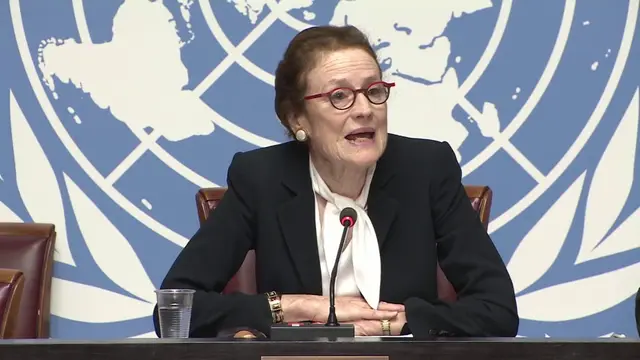 Play video: UNICEF on Yemen: "Without peace, we cannot help these children" (3 July 2017)
The video loads from YouTube when you play it.
These are excerpts from her briefing.
The cost of the war
Almost 10,000 people have died since a Saudi-led military coalition began fighting in Yemen in 2015. The coalition aims to restore the internationally recognised government, after Houthi rebels took over Sana'a the year before.
At least 2,200 children have been killed and 3,400 injured, UNICEF said. The real numbers may be even higher.
Health and education have collapsed
"We have been very worried about the collapse of two systems: one is the healthcare system, and the other is the education system," Fore said. "But when you go to Yemen, what you meet are officials who say: no, no, no, it actually has collapsed."
Hospitals have been damaged. Schools have become shelters or have been taken over by armed groups. Some 1,500 schools have been damaged in airstrikes and shelling in the past three years.
Doctors, nurses and midwives have not been paid for up to 2 years, yet they still come to work despite the risk of cholera. Teachers have not been paid either. Half of the schools are closed, and young people are out on the street.
"22 million people are in need – that is an extraordinary number – and 11 million of those are children," Fore said. "80% of the population is below the poverty line, eight million four hundred thousand are on the brink of famine, and a child dies every ten minutes. That is more than the population of Switzerland."
Hodeidah
In Hodeidah, a Saudi-led coalition offensive is trying to drive out the Houthi rebels. 5,000 families have fled their homes there in the past two weeks. Shops, bakeries and restaurants are largely closed, so there are few supplies in the market.
"Things are getting worse," Fore said. "There are severe water shortages, and electricity is unavailable in most parts of the city. Prices are up for all the basics – grains and cereals, cooking oil, cooking fuel. At least a quarter of a million women and children are in dire need of medical items. One in four children is acutely malnourished, and cholera cases are reported to be rising. The escalation of violence means that many streets are now being trenched, which affects the water supply and the electricity."
Paying the people who keep services going
UNICEF has been paying incentives to health workers in hospitals. The agency would like to do the same in education, to keep schools open, since many teachers have fled the violence and no longer live in their communities.
"The incentive payments to health workers, educators and sanitation workers make a big difference, and cash transfers to the people themselves make a big difference. We need to do more of it," Fore said.
Together with the World Bank, UNICEF runs a cash-plus transfer programme for the very poorest families. It reaches some 9 million people, a third of the country. Each family receives US$40 for a 3-month period.
Child soldiers, trafficking and child marriage
Fore also warned of another serious danger for children. "They are very vulnerable to being recruited as child soldiers, and very vulnerable to child traffickers," she said. "Yemen has always been a transit point. There are groups that will abduct children and traffic them, as child soldiers or as child brides."
"Early child marriage is a continuing problem and a growing problem," she added. "With so much poverty, if you can place a child – a boy or a girl – in someone else's household or in a militia, you do so, because you cannot afford to feed them."
Cholera
Yemen's cholera outbreak is widely considered one of the largest documented epidemics in modern times. "People are still streaming in, many older people but also younger people, with cholera and severe acute watery diarrhoea," Fore said. "All of this can kill a child. The under-five mortality rate remains very high. So we are worried."