Female photographers challenge taboos in Yemen
Yemeni women photographers and models are challenging social taboos in their country. After some difficulties at the start of their careers, they now say they can do their work with pride. This report was filmed on 29 Dec 2016.
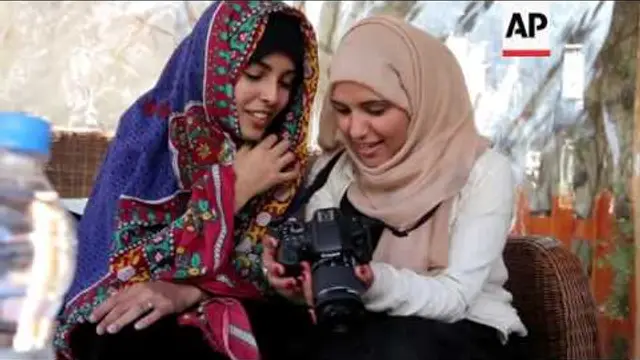 Play video: Female photographers challenge taboos in Yemen
The video loads from YouTube when you play it.
"I found my soul in photography"
Photographer Sahya Al-Asbahi is hard at work. She is one of a small number of professional women photographers in Yemen.
It started as a hobby while she was a pupil at the German school in Sana'a. It grew into a passion and finally into paid work.
"I was taking pictures of the simplest things as a hobby. I loved photography. Photography is a spirit. I felt that I found my soul in photography. The photo is a drawing for me, something alive that is moving, greater than words."
She calls her camera "my sweetheart". As the civil war goes on, she fears for it because of "the militiamen who roam Sanaa's streets".
She photographs people displaced from Yemen's war zones for humanitarian organisations, and she also takes pictures at social celebrations. Her parents support her on the condition that she "respects morals and religion".
Work in a conservative country
Work like this is hard in a conservative country like Yemen. Women here face severe discrimination in law and in practice. They cannot marry without the permission of their male guardian. They do not have equal rights to divorce, inheritance or child custody.
Photographer Abeer Aziz finds support in her fiancé, who she says is open-minded. Her hobby started four years ago with snapshots on a mobile phone. She then took a course and bought a camera.
Her dream is to become a "renowned photographer" and to take pictures all over the world "without being harassed".
"As soon as they see you holding a camera and shooting, some speak badly to you. Some say: 'Why do you shoot here? Go to your home. A woman should be at her home, in the kitchen'," says Aziz. She adds that she has also been spat on.
Iman al-Abssi, 24, cannot afford a camera, so she borrows one from a friend. She is a TV presenter, but she has been out of work since the war ended her programme about tourism. Still, she says things are improving, and more people now accept her as a woman photographer.
In front of the camera
Wedyan Almamary has another passion: she works in front of the camera.
"At first, there were some difficulties, and I used to obey people. Later, I tried to be more positive. Thanks to Allah, my family supported me. The people around me are proud of me. I did not listen to society, because if you listen to society you will do nothing."
Posing as a model was her way of pushing against the norm in a country where most women would not go outside with their face uncovered.
She works as a journalist at a media company, and a photographer asked her to pose. She has since appeared in nine commercials and taken part in "numerous" local fashion shows. The dresses she wears are long and show no skin.
"Women have proven their role"
Mona Abdallah, an activist on women's issues, believes the conflict has, strangely, been a catalyst for new ideas. Though painful, it has loosened the constraints on women.
"In the past it was impossible to see young women who were not veiled. We did not see young women in the media, only a small number: two or three, four, or even ten. But society's view has changed, and there is awareness now. We find young women in every field and at every level. We find the politician, the journalist, the media worker, the photographer, the model, the professor, the doctor."
"We find women at all levels, and they have proven their role," she adds.